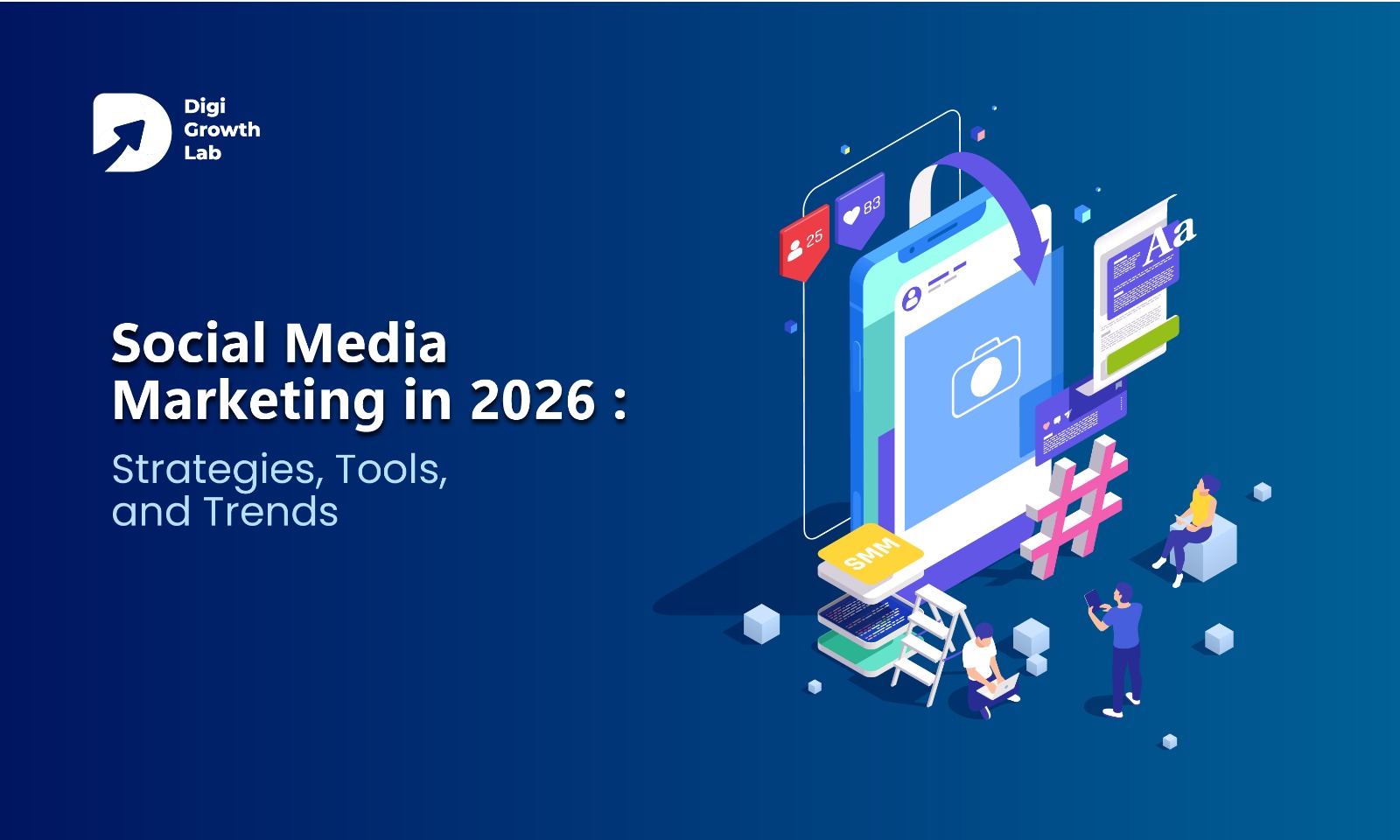
Social Media Marketing in 2026: Strategies, Tools, and Trends

Summary: Social media marketing in 2026 is no longer about chasing likes or posting daily it’s about winning visibility in AI-driven feeds, turning platforms into storefronts, and building trust-first communities. This blog reveals the strategies, tools, and trends that will help your brand stay relevant, earn loyalty, and drive measurable growth in the year ahead.
Social media is changing faster than ever. In 2026, it’s no longer just about posting content or chasing like platforms that have turned into AI-powered search engines, shopping hubs, and community spaces all at once.
For any business working with a social media agency or managing accounts in-house, the real challenge is clear: how do you stand out when every feed is driven by algorithms and every platform is selling something?
This blog cuts through the noise. Instead of recycled tips, you’ll find the strategies, tools, and trends that matter in 2026 fresh insights to help you stay ahead while others are still playing catch-up.
The Evolution of Social Media Marketing: 2020 → 2026
The last six years have completely reshaped how brands use social media, yet not in the way most marketers expected. Here’s what really changed:
From influencers to algorithms. In 2020, growth was fueled by influencers with huge followings. By 2026, it’s not the size of an account but how well your content matches an AI-driven feed. Reach is no longer “bought”; it’s earned through relevance.
From paid targeting to data scarcity. Privacy updates stripped away many of the shortcuts advertisers relied on. Marketers who once leaned on hyper-specific targeting now have to build stronger first-party data strategies and rely on creativity to win attention.
From social content to social search. TikTok, Instagram, and even LinkedIn now act as search engines. People don’t just scroll, they search with intent, expecting quick, trustworthy answers inside the platform itself.
From selling products to selling experiences. Social commerce has matured. Audiences don’t just want a buy button they want live shopping, authentic reviews, and content that feels like community, not advertising.
For a business working with a social media marketing company, the lesson is simple: every leap forward made social media less about broadcasting and more about being discovered, trusted, and chosen inside the platform itself.
Core Strategies for 2026: What Smart Brands Will Actually Do
By 2026, the old playbook of “post consistently, run ads, work with influencers” won’t cut it. Platforms, users, and algorithms have changed too much. Here are strategies forward-thinking brands are already testing, and you’ll need to master if you want to stay ahead.
Design Content for AI Overviews
Social feeds are becoming AI-driven discovery engines. TikTok’s “smart search,” LinkedIn’s AI copilots, and Meta’s generative answers mean your posts are being summarized and recommended by algorithms, not just seen by followers. The strategy: structure captions and hooks like answers to real questions. Think: “What’s the easiest way to keep a car fresh in summer?” → instead of “New product launch 🚗✨.” Brands that do this will appear in AI-generated results before competitors.
Micro-Communities Over Mass Reach
In 2026, smaller groups are more powerful than big follower counts. Users trust a 200-member WhatsApp community or a Discord group more than a 2-million-follower page. Winning brands will build private, high-trust spaces around niches—then use them to seed content back into public feeds.
Data-Backed Creativity
Since privacy killed hyper-targeting, creativity is your target. But creativity in 2026 isn’t random; it’s informed by first-party data. Smart brands are running micro-tests (different visuals, hooks, or sounds), then feeding those learnings into platform algorithms. The creative is the strategy.
Hybrid Influencers: Real + Virtual
Influencer marketing isn’t dead—it’s splitting. Alongside real creators, we’ll see AI-generated “synthetic influencers” with their own loyal followings. The fresh strategy is mixing both: collaborate with a real creator for trust, and a virtual one for 24/7 scalable content.
Social as Your Customer Service Desk
By 2026, more customer queries will happen in Instagram DMs, LinkedIn messages, or TikTok comments than email. Treating social as a help desk—integrating chatbots, AI reps, and human agents turns every interaction into retention. Most competitors ignore this, but it’s where loyalty is built.
Platform-Native Commerce Funnels
Instead of pushing everyone to a website, smart brands are building full funnels inside platforms: TikTok Shop for awareness + purchase, Instagram for reviews, WhatsApp for repeat orders. In this model, each platform is a self-contained funnel, not just a traffic source. A skilled social media management service can map and automate these mini-funnels for you.
Social Media Tools Marketers Must Master in 2026
By 2026, there’s a tool for everything posting, listening, analyzing, even talking back to your customers. The problem isn’t a lack of options. It’s knowing which tools actually move the needle for your business. Here’s a smarter way to think about them:
Match Tools to Your Growth Stage
Startups / Small Businesses → You don’t need enterprise dashboards. Look for all-in-one platforms (e.g., scheduling + analytics + light design) that save time without bloating costs.
Scaling Brands → As campaigns spread across TikTok, Instagram, and LinkedIn, you’ll need tools that unify reporting and attribution. This is where investing in advanced analytics or an external social media agency makes sense.
Enterprises → At this level, it’s not about tools—it’s about integration. Choose platforms that connect CRM, paid media, and customer service into one ecosystem.
Choose AI That Fits Your Brand, Not Just Your Budget
In 2026, almost every tool has “AI” slapped on it. The trick is to ask: Does this AI understand my audience?
If it only speeds up posting → it’s a time-saver, not a growth driver.
If it learns from your data and adapts content to your tone → that’s worth paying for.
Prioritize Search + Commerce Readiness
Tools that track reach are outdated. Instead, ask: Can this tool tell me if my posts are showing up in TikTok search? Can it connect likes to actual in-app purchases?If the answer is no, it’s probably not future-ready.
Think Community, Not Just Content
By 2026, real value comes from owning conversations, not just pushing posts. Tools that let you manage communities (Discord, WhatsApp, private forums) and combine that with listening (to catch early signals) are far more powerful than another design app.
The “One-Question” Test Before You Buy
Before adding any new platform, ask: Will this tool make me closer to my customer, or just make reporting prettier? If it doesn’t pass that test, skip it.
Trends Beyond the Basics: Where Social Media Is Really Headed in 2026
Most blogs will tell you “AI is growing” or “short videos still matter.” That’s not news. What matters in 2026 are the less obvious shifts that will quietly decide who wins attention and who disappears. Here’s what smart marketers are watching:
Content Moderation by AI — and How It Affects Reach
In 2026, algorithms don’t just recommend posts, they filter them. AI moderation systems flag anything that looks spammy, sales-heavy, or even emotionally flat. The result? Posts that feel human rise higher, while templated content silently gets buried. The takeaway: stop over-polishing. Posts with small imperfections (like natural phrasing, real photos, or conversational tone) perform better than “AI-slick” content.
Platform Gatekeeping: Pay-to-Play Isn’t Optional Anymore
Organic reach is shrinking fast. Platforms like TikTok Shop and Instagram Checkout are prioritizing posts tied directly to their own commerce tools. If your funnel isn’t built inside the app, you’ll get less visibility no matter how good your content is. Translation: treat every platform as its own storefront not just a traffic driver.
Cross-Platform Micro-Commerce
Forget chasing one viral video. In 2026, growth comes from hundreds of micro-sales moments across different apps: a TikTok tutorial with a buy link, a WhatsApp reorder button, a LinkedIn carousel leading to a B2B demo. Smart brands don’t rely on one big campaign; they stitch together small conversions across multiple channels.
The Rise of “Authenticity Audits”
Users are skeptical. They’ve seen too many ads disguised as content. In response, platforms are introducing authenticity checks: labeling AI-generated posts, highlighting verified creators, and boosting UGC over branded stock content. The trend? Real reviews, behind-the-scenes clips, and unpolished stories are ranking higher than glossy campaigns.
Algorithmic Bias Becomes a Marketing Challenge
AI-driven feeds are trained on patterns which means they often favor certain styles, tones, or even demographics. If your content doesn’t “fit the mold,” it may never surface. The new skill for 2026 is learning how to train the algorithm with consistent signals: posting at steady rhythms, using predictable formats, and feeding the platform the kind of engagement it already rewards.
Social Media Metrics That Actually Matter in 2026
If you’re still tracking followers and likes as your main success indicators, you’re reading the wrong dashboard. In 2026, those numbers barely scratch the surface. What matters now are signals that show whether your brand is cutting through AI-driven feeds, building trust, and actually driving sales.
Here are the new-age metrics smart marketers are watching:
Share of Algorithmic Shelf
Think of every feed as a digital supermarket. The “shelf space” is what the algorithm decides to show. The key metric is no longer reach, but: how often is my content selected by the algorithm compared to competitors in my niche? Some platforms are quietly releasing “visibility share” data, and it will soon be the new SEO ranking.
Contribution to Customer Memory
Not every post leads to a sale but every post either makes your brand more memorable or forgettable. Track repeat exposure: how many times the same user interacts with your brand in a month. In AI-curated feeds, memory is the difference between being a one-time scroll and a lasting choice.
Speed-to-Action
Attention spans are collapsing. Measure how quickly a user moves from seeing your content to taking the next step (click, comment, save, buy). Brands that shorten this window — through frictionless design or in-app commerce will dominate.
Trust Signals per Post
Algorithms are quietly rewarding content that sparks meaningful signals: saves, shares, long comments, even profile visits. Instead of just “engagement rate,” track how many trust signals your posts earn. One thoughtful comment is worth more than 50 likes.
Community Gravity
This is about pull, not push. Measure how many people return to your spaces: Discord groups, broadcast channels, or recurring livestreams. Gravity tells you if your community sticks or if you’re constantly spending to replace churn.
How Businesses Can Prepare for the Next Wave
Most businesses know social media is changing, but here’s the uncomfortable truth: by the time a trend makes it to competitor blogs, it’s already too late. Preparing for 2026 means focusing on the shifts most brands aren’t paying attention to yet.
Audit Your Brand for AI Bias
In 2026, algorithms don’t just amplify content, they judge it. If your posts look too promotional, too repetitive, or too AI-polished, they quietly get downranked. Smart brands are already running “AI audits” on their own content: testing how posts are summarized by TikTok AI or whether LinkedIn’s copilot surfaces them in suggestions. If the algorithm wouldn’t trust your content, your audience won’t even see it.
Prepare for Invisible Commerce
The next wave of sales will happen where customers barely notice they’re buying — a one-click reorder in WhatsApp, a shoppable frame in a TikTok video, a carousel that doubles as checkout. To get ready, map your customer journey inside each platform, not outside it. If you’re still forcing users to leave the app, you’re adding friction your competitors won’t.
Treat Communities Like Products
In 2026, your Discord group or private broadcast channel isn’t just a “supporting asset” it’s a product in itself. The smartest brands are assigning community managers the same way they assign product owners. The ROI isn’t just sales; it’s loyalty, referrals, and free UGC that powers the next campaign.
Build a Transparency Playbook
AI-generated content floods feeds, and audiences don’t know what’s real. Brands that hide behind polish will lose trust fast. Forward-looking companies are preparing transparency playbooks: showing sourcing, revealing when AI helped, and putting real humans front and center. In a world full of synthetic voices, showing your face is a strategy.
Train for Algorithmic Negotiation
This may sound futuristic, but it’s already happening. Platforms reward behaviors they want (longer watch time, native shopping, ad spend). If your team doesn’t understand how to “negotiate” with each algorithm by feeding it the right signals, you’ll always pay more for less reach. Training your staff to read and respond to algorithmic signals is the new media buying.
Final Thought
Social media in 2026 isn’t just another marketing channel, it’s where discovery, trust, and transactions all happen at once. The brands that thrive will be the ones that adapt early: auditing for AI bias, building mini-funnels inside platforms, and treating communities as seriously as products.
It’s a lot to manage, and most businesses don’t have the time or in-house expertise to stay ahead of every shift. That’s where Digi Growth Lab comes in. As a forward-thinking social media agency, we don’t just schedule posts, we help you design strategies that work in AI-driven feeds, nurture private communities, and turn your social platforms into revenue engines.
The next wave of social media is already here. The only question is whether you’ll ride it or watch competitors pass you by.